
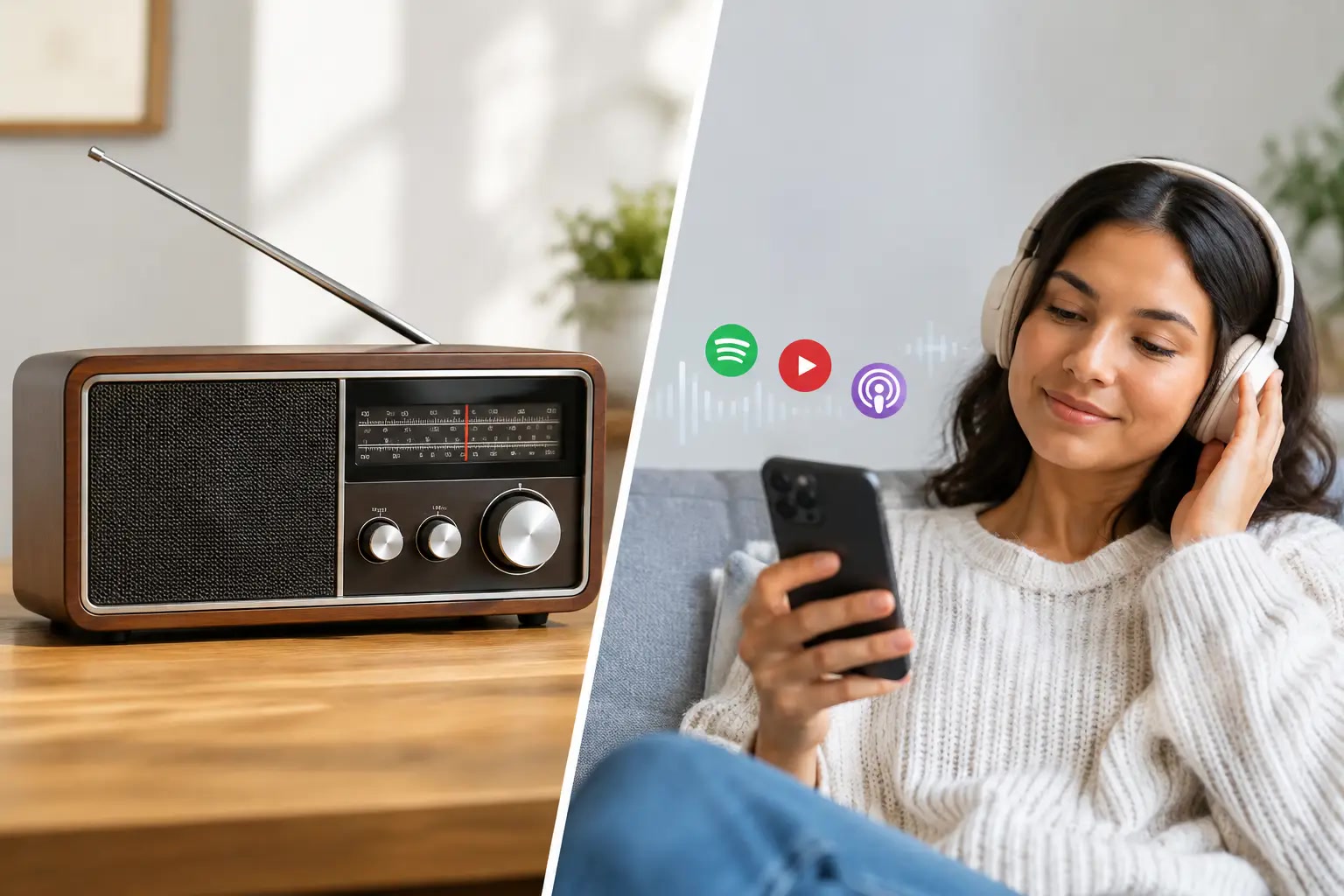
A roofing company does not need every listener in town to hear its ad. It needs homeowners with an aging roof, a local address, and a reason to act before the next hard rain. That is the real question behind radio ads versus streaming ads: not which channel is newer or more popular, but which one can create enough qualified response to justify the spend.
For small and regional businesses, the right answer is rarely an either-or decision. Radio remains a powerful local reach engine. Streaming brings tighter audience controls and richer campaign data. The best media plan starts with the business goal, connects ads to a trackable conversion path, and gives the sales team evidence to act on.
Traditional radio buys access to a station's audience during a defined schedule. You are purchasing the context of a trusted local brand, the habits of listeners, and broad reach across a market. Morning drive, lunchtime, and afternoon commute still matter because those routines are real.
Streaming advertising buys audience segments and impressions across digital audio environments. That may include music streaming, digital radio, podcasts, and connected devices. Rather than choosing only a station and daypart, an advertiser can often target by geography, age range, interests, listening behavior, or device type.
That distinction matters, but it should not become a false promise. Streaming targeting is more precise, not magical. A segment labeled "in-market homeowner" is a modeled audience, not a signed purchase order. Radio audiences are less individually addressable, but a well-chosen local station can deliver a highly relevant group at scale.
The practical difference is this: radio is often strongest when you need market-wide awareness and local credibility. Streaming is often strongest when you need controlled reach, audience testing, and more granular delivery reporting.
Radio works because people build relationships with stations, hosts, and programming. A local business does not just borrow airtime. It can borrow familiarity. When a listener hears the same HVAC company during weather updates, traffic reports, and a favorite morning show, that repetition can create a useful mental shortcut when the furnace fails.
It is also efficient at reaching people who are not actively searching yet. Search advertising captures existing intent. Radio can create it. A memorable offer or a sharp problem-solution message can put a business on the shortlist before a customer opens a browser.
For many local brands, radio is especially useful for seasonal campaigns, grand openings, community events, recruitment, and services with a wide customer base. A credit union, auto dealer, home-services company, healthcare provider, or regional retailer may benefit more from broad local presence than from narrow audience filtering.
The trade-off is measurement. A station can report scheduled spots and estimated audience delivery, but that does not automatically explain which ads created calls, form fills, store visits, or closed revenue. Businesses that treat radio as unmeasurable are leaving value on the table. Businesses that expect perfect one-to-one attribution without the right systems are setting themselves up for disappointment.
Use a dedicated landing page, a unique phone number, offer code, or a memorable vanity URL. Better still, connect campaign delivery, website behavior, call activity, and lead outcomes in one reporting view. That is how radio moves from a leap of faith to a managed growth channel.
Streaming lets advertisers shape a more controlled audience. A financial advisor might focus on listeners within a defined radius and selected age bands. A B2B provider may prioritize job titles, industries, or business-interest segments where available. A restaurant group can limit delivery to listeners near specific locations.
This control makes streaming useful for testing. You can compare offers, creative versions, geographic areas, and audience groups without committing an entire campaign to one broad placement. Frequency can also be managed more deliberately, helping reduce wasted impressions or ad fatigue.
Streaming has another operational advantage: digital delivery creates more data points. Advertisers can see impressions served, completion rates, reach estimates, frequency, device categories, and sometimes site visits or conversion activity. Those metrics are useful, but they need interpretation. A completed audio ad is not the same as a qualified lead. A high click-through rate can be less valuable than a lower-volume campaign that produces better calls and booked appointments.
Streaming performs best when it is connected to a conversion-ready destination. If the ad asks listeners to visit a site that loads slowly, buries the offer, or offers no clear next step, precise targeting will not rescue the campaign. The ad, landing page, tracking, and follow-up process must work as one system.
The cheapest cost per thousand impressions is not always the cheapest way to acquire a customer. This is where many media decisions go sideways. A low-cost streaming buy may look efficient on a delivery report but reach people with little ability or reason to purchase. A more expensive radio schedule may generate fewer measurable digital actions while producing a stronger lift in branded search, direct calls, and sales conversations.
Evaluate cost against the action that matters. For a service business, that may be qualified calls and booked estimates. For a retailer, it may be store traffic and offer redemptions. For a media seller, it may be advertiser renewals supported by credible delivery and response reporting.
Frequency deserves equal attention. One exposure rarely changes behavior. Radio's strength is repetition within a familiar environment. Streaming can control frequency, but overly tight caps may weaken recall before a message has time to land. The right frequency depends on the buying cycle, creative quality, competition, and campaign duration.
A short promotion may need concentrated reach. A brand-building campaign needs consistent presence over time. Do not judge either channel after a handful of spots or a few days of impressions. Give the message enough runway to create recognition, then optimize based on results.
The strongest campaigns use radio and streaming for different jobs. Radio can establish local awareness and trust. Streaming can reinforce the message among defined audiences and drive listeners toward a specific online action. Search, social retargeting, email, and sales follow-up can carry the prospect from interest to conversion.
For example, a regional contractor could run radio ads that make a seasonal maintenance offer memorable across the market. Streaming can then focus on homeowners near priority service areas, using a version of the message that drives to a short estimate-request page. When people search the company name after hearing either ad, a conversion-focused website should make the next step obvious.
This is not channel stacking for its own sake. Each component should answer a business question. What creates awareness? What captures demand? What proves delivery? What helps the sales team follow up faster? If a channel has no defined role, it is probably consuming budget without contributing to a system.
Neither radio nor streaming should live in a reporting silo. The business needs a clear view of what aired or served, where it ran, what creative was used, and what happened afterward. That includes calls, web sessions, form submissions, appointment requests, CRM opportunities, and revenue when possible.
For radio and podcast sales teams, this level of proof can materially improve renewal conversations. Instead of saying a campaign "received great exposure," sellers can show delivery, response trends, and the next optimization to test. Tools such as Archway's Adyes help connect audio advertising activity to attribution data that clients can understand.
Attribution will never be perfect. People hear an ad in the car, search later on another device, ask a spouse, visit a location, and convert days afterward. That does not make measurement pointless. It means reporting should combine direct response signals with broader indicators such as branded search growth, geographic lift, call quality, and sales outcomes.
Choose radio first when broad local awareness, trusted station environments, and repeated market presence are the priority. Choose streaming first when you need audience controls, faster creative testing, geographic precision, and richer digital delivery data.
Choose both when the market is competitive, the customer journey is not immediate, and your team has a clear way to capture and follow up on demand. A blended campaign can give a local business the reach of broadcast and the optimization capability of digital audio without treating either channel as a standalone tactic.
The smarter question is not whether radio or streaming wins. It is whether your advertising can be heard, remembered, measured, and turned into a next step your team can actually close.
We help local businesses connect audio campaigns to landing pages, calls, and lead outcomes so the mix is chosen by results.