
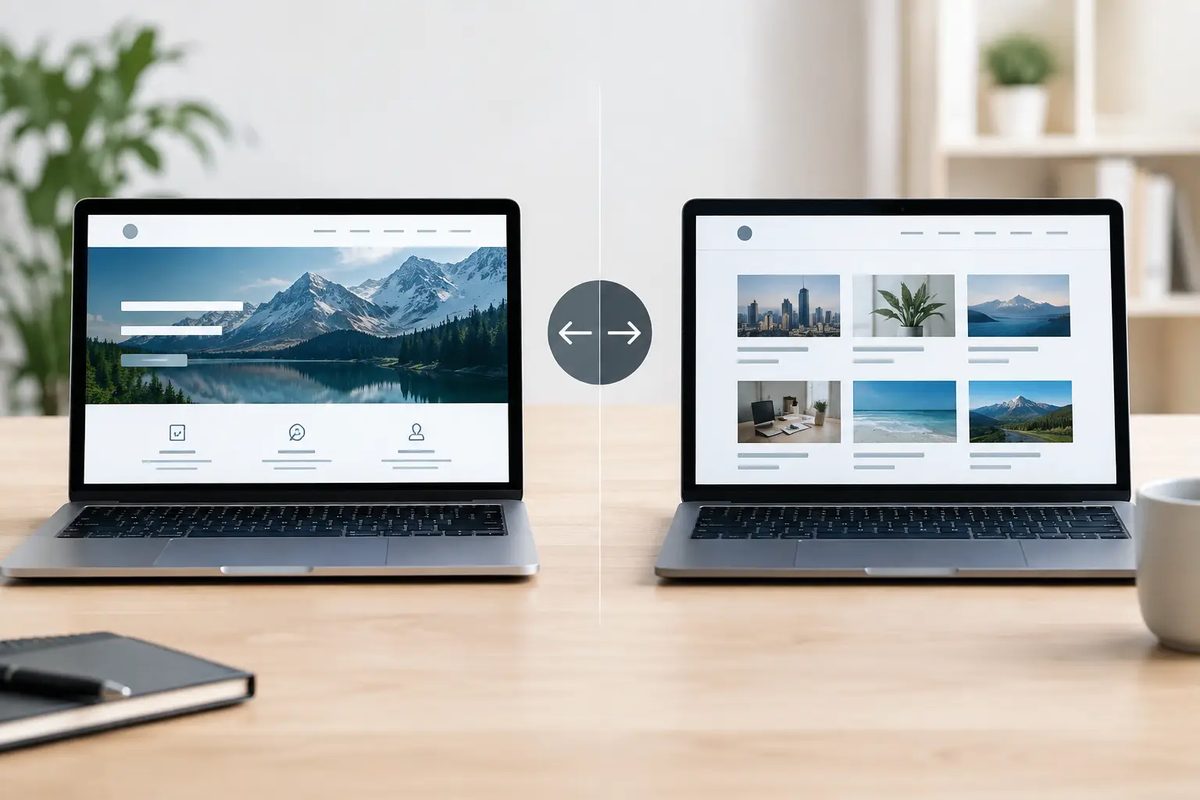
A website can look polished and still fail at its actual job. If it does not explain your value, move the right visitor toward action, and connect cleanly to the systems behind your sales process, it is not growth infrastructure. It is a digital brochure with better lighting.
The custom website versus template website decision is not really about whether one option looks nicer. It is about what your business needs the site to do over the next several years: generate leads, support ad campaigns, automate follow-up, prove marketing ROI, or simply establish a credible online presence without overinvesting.
For some businesses, a template is the correct answer. For others, it becomes an expensive shortcut because the limitations show up just as marketing begins to work.
A template website starts with a prebuilt layout. You select a theme, replace placeholder copy and images, adjust colors, add pages, and publish. Modern platforms make this fast, and a well-configured template can be professional enough for a new business, a simple local service company, or a campaign with a narrow purpose.
A custom website is designed and developed around your business model, audience, offers, sales process, and marketing goals. That does not mean every line of code must be invented from scratch. Good custom development uses reliable tools and proven components where they make sense. The difference is that the architecture, user journey, content structure, and conversion paths are built for your operation rather than forced into a theme's assumptions.
Think of a template as a furnished office suite. You can move in quickly, and it may serve you well. A custom site is an office designed around how your team works: where clients enter, where paperwork moves, where conversations happen, and where bottlenecks should disappear.
Templates earn their popularity. They reduce launch time, lower upfront cost, and give business owners a practical way to get a credible web presence online. If your primary need is a handful of informational pages, a basic contact form, and a clean mobile experience, a template may deliver exactly the right level of capability.
They work particularly well when the business is still validating its positioning. A new company may not yet know which service will become its most profitable offer, what questions prospects ask before buying, or which audience segment responds best. Spending heavily on a detailed custom build before learning those answers can be premature.
A template can also be a good fit when speed matters more than differentiation. For example, an event landing page, a short-term recruiting push, or an early-stage product test may need to launch quickly. In that situation, the goal is not to build a permanent marketing platform. The goal is to gather signal, generate response, and decide what deserves more investment.
The trade-off is that templates often come with structural baggage. They may load unnecessary scripts, make unusual page layouts difficult, or encourage every page to look and behave the same way. Those issues are manageable until your website needs to support more than basic visibility.
The sticker price of a template can be appealing, but the purchase price is not the full cost. The real question is how much time and revenue the site costs when it cannot support the next stage of your marketing.
Many businesses discover this when they begin running paid search, radio, podcast, or social campaigns. Traffic arrives, but the landing page is generic. The offer is buried in a navigation menu. Forms send inquiries into an inbox with no source tracking, no automated follow-up, and no way to identify which campaign produced a qualified lead.
That is not an advertising problem. It is a website system problem.
Templates can also become difficult when a company needs specialized functionality: location-specific service pages, calculators, resource libraries, gated content, sales-team routing, CRM integrations, dynamic forms, appointment workflows, or client portals. A capable developer can sometimes customize a template around those needs. But each workaround adds complexity, and the result may become harder to update, test, and maintain.
Then there is sameness. A template is not automatically generic, but popular themes give competitors access to the same visual starting point. If your company wins through expertise, a specialized process, premium service, or a different customer experience, a site that feels interchangeable works against your positioning. The trust signals that convince a buyer to call are harder to earn when your site looks like three competitors' sites.
Custom does not mean adding animation to every section or making visitors play a scavenger hunt to find a phone number. It means making deliberate choices around performance and outcomes.
A conversion-focused custom website starts with how customers make decisions. What problem brings them to the site? What proof do they need? Which offer matches their level of urgency? What is the simplest next step? Those answers shape navigation, page hierarchy, calls to action, forms, content, and automation.
For a service business, that could mean distinct paths for emergency buyers, research-stage buyers, and commercial prospects. For a media company, it may mean giving advertisers a clear route from available inventory to creative approval and campaign reporting. For a sales organization, it may mean turning web inquiries into assigned opportunities with immediate follow-up.
A custom build also creates a cleaner foundation for SEO. Search performance is not guaranteed by custom code, and no honest agency should suggest otherwise. Strong SEO still requires useful content, technical quality, clear site structure, local relevance where applicable, and ongoing publishing. But a custom site makes it easier to create purpose-built page templates, control internal linking, improve load performance, and organize content around the searches that lead to revenue.
Most importantly, custom development gives you room to improve. Marketing is not a one-time launch. Your best landing page may change after a campaign reveals new objections. Your form may need fewer fields. Your sales team may need better lead context. A website built as part of a connected system can evolve without needing to be rebuilt every time the business learns something useful.
A template typically has the lower upfront cost. A custom website requires more discovery, strategy, design, development, testing, and quality control. That investment is justified only when the additional performance or operational efficiency matters to the business.
The better comparison is not "$2,000 versus $12,000" or any other pair of numbers. Compare the cost against the value of a qualified lead, the volume of leads you expect, the time your staff spends manually handling inquiries, and the revenue lost when campaigns send traffic to weak pages.
If one additional customer per month covers the difference, custom may be the more economical choice. If the website mainly serves as an online business card and your pipeline comes from referrals, a template may protect capital for a more immediate need.
There is also a middle ground. A business can begin with a focused, affordable custom site rather than a massive project. Start with the high-value pages, the right tracking, conversion paths, and an architecture that can expand. This approach avoids paying for features you do not need while avoiding the trap of building on a foundation that cannot grow.
Before choosing a platform or approving a design, ask what must happen after someone visits the site. If the answer is simply "they should know we exist," a template may be enough. If the answer includes booking, qualifying, assigning, nurturing, tracking, reporting, or renewing, the site needs to be treated as an active part of your marketing and sales operation.
Also ask who will maintain it. Template builders are often easier for internal teams to update, but ease of editing should not be confused with ease of managing a high-performing site. Clear page components, documented workflows, and a purposeful content system can make a custom website manageable without turning every edit into a developer ticket.
Finally, consider the cost of delay. A site that is fast to launch but slow to improve can create a false sense of progress. A more strategic build takes longer at the beginning, but it can give every future campaign a better place to land.
Start with the customer action that creates value, then build the pages, automation, tracking, and proof needed to make that action easier.
We will look at how your site needs to perform over the next few years, including leads, campaigns, follow-up, and reporting, and tell you plainly which option fits and what it should cost.