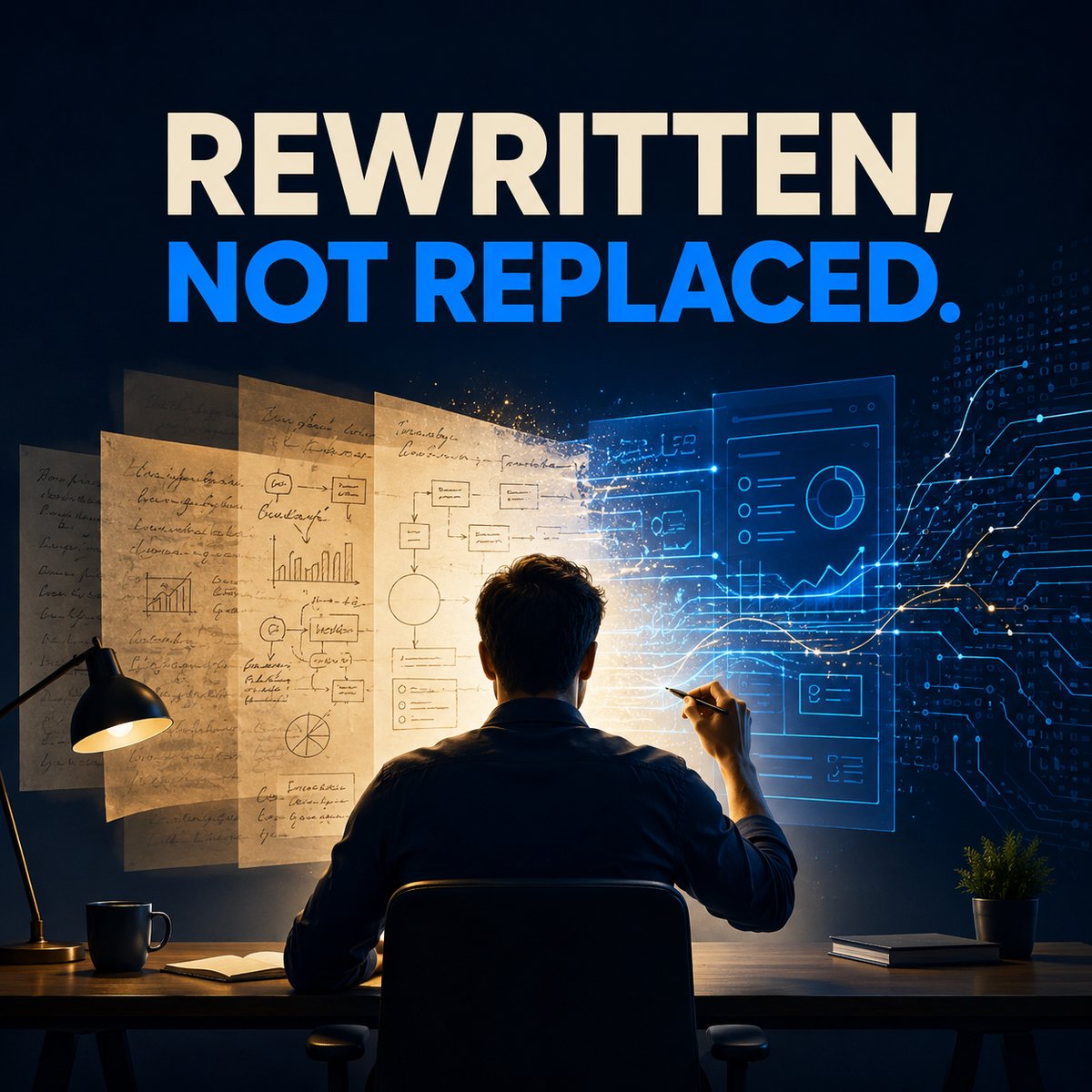
The real change coming from artificial intelligence is not the disappearance of most jobs—it is the redesign of how those jobs are performed.
Headlines frequently describe AI as a technology that will replace workers. That may happen in certain narrow roles, but it misses the bigger transformation already underway.
Most jobs are collections of many different tasks. Some require judgment, creativity, empathy, persuasion, leadership, or hands-on experience. Others involve copying information, organizing documents, preparing reports, scheduling appointments, or writing the same type of message repeatedly.
AI is more likely to replace individual tasks before it replaces entire occupations.
Consider the work of a salesperson.
A salesperson may research prospects, enter information into a CRM, write emails, prepare proposals, conduct demonstrations, negotiate agreements, and build relationships with customers.
AI can help research companies, summarize previous conversations, draft follow-up emails, update records, and prepare an initial proposal. However, the salesperson is still needed to understand the customer, ask better questions, earn trust, handle objections, and close the sale.
The job still exists, but the way it is performed has changed.
The same pattern applies across many industries:
AI handles parts of the process. People remain responsible for the outcome.
The first tasks to be rewritten will often be those that simply move information from one place to another.
These tasks include:
These activities may be necessary, but they do not always require a person's full creativity, experience, or attention.
When AI handles some of this administrative work, employees can spend more time solving problems, serving customers, creating new ideas, and building relationships.
That is the real opportunity: not simply doing the same amount of work with fewer people, but helping people accomplish more valuable work with the time they already have.
AI can generate an answer quickly, but it does not automatically know whether that answer is useful, accurate, appropriate, or aligned with the needs of a particular business.
That is where experience matters.
An experienced salesperson can recognize when an AI-written email sounds impersonal. A skilled mechanic knows when a suggested diagnosis does not match what the vehicle is doing. A knowledgeable marketer can identify content that sounds polished but says nothing meaningful.
AI can help produce options. Experienced people determine which option is right.
The strongest employees will not be those who blindly accept everything AI produces. They will be the people who know how to ask good questions, check the results, improve the work, and apply it to a real situation.
People do not need to become programmers to benefit from AI. They need to learn how to describe what they want clearly and evaluate what they receive.
That may mean asking AI to:
Buying an AI subscription does not create a successful AI strategy.
Businesses need to examine how work is currently performed and identify where employees lose time. They should look for repeated steps, duplicate data entry, communication bottlenecks, and processes that depend on someone manually moving information.
Then they can test AI on one clearly defined task.
A useful AI project should answer four questions:
Starting small makes it easier to catch mistakes and demonstrate real value. Once the process works, it can be expanded.
Do not wait for your employer to announce a major AI initiative.
List the five tasks you performed most often during the past week. Circle the ones that primarily involved moving, organizing, summarizing, or rewriting information.
Choose one circled task and test whether AI can help you complete it faster. Do not begin with confidential customer information or sensitive company data. Use a safe example and compare the AI-assisted result with your normal process.
The goal is not to hand your entire job to a machine. The goal is to remove one low-value step so you can spend more time on work that requires your judgment and experience.
The future of work is unlikely to be divided neatly between jobs performed by people and jobs performed by machines. Most workplaces will combine human knowledge with AI-assisted processes.
The job title may remain the same while the daily responsibilities change significantly.
Employees who learn how to use AI responsibly will be able to research faster, communicate more clearly, and make better use of their time. Companies that approach AI thoughtfully can improve productivity without sacrificing judgment, accountability, or customer relationships.
Most jobs will not disappear overnight.
They will be rewritten one task at a time.
Which repetitive task in your current job would you hand to AI first, and what higher-value work would you do with the time you saved?
We help small and medium businesses identify where AI can rewrite workflows, not replace people—freeing your team to focus on what matters most.